

A current HCI research study#
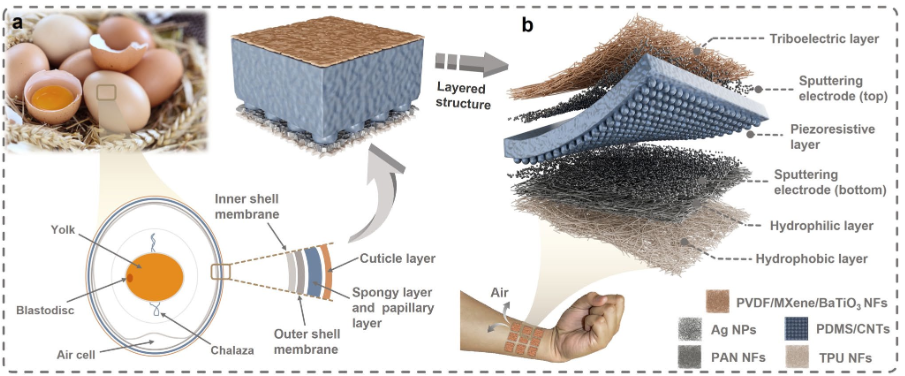
In this section, I will present the recent work of Weiwei He, who is working (together with other researchers) on a Biomimetic Flexible Sensor inspired by the natural layered structure of eggshells.This work was inspired by the great potential that biomimetic innovations have shown in recent years.
Their team designed the eggshell-inspired multifunctional hybrid flexible sensor (EMHFS), which uses 4 functional layers : a triboelectric layer for noncontact sensing, a piezoresistive layer for pressure sensing, and hydrophilic–hydrophobic layers for directional moisture wicking, breathability, and antibacterial properties.
This new flexible sensor can be useful for a variety of HCI scenarios, such as wearables, robotics or smart interactives devices.
The Ultimate Display, by Ivan Sutherland#
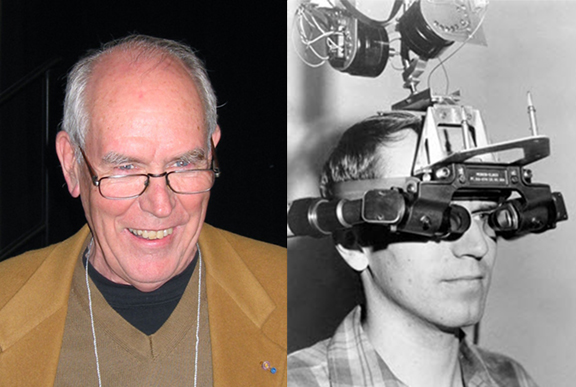
In this foreshadowing paper from 1965, Ivan Sutherland predicts how Human-Computer Interfaces could evolve in the future. Nowadays, we can see that his prediction where quite precise !
He predicted that computers will be interacted with using a keyboard (a “typewriter”), the apparition of drag-and-drop interfaces as well as voice inputs. He also conceptualized what became haptic feedbacks, where the user can feel resistance when interacting with an object.
Sutherland also describes technologies we don’t know of yet. The haptic feedbacks he imagined still isn’t as advanced today, so there is still room for improvement and many innovations could emerge in the upcomig years. His ultimate ambition is “a room within which the computer can control the existence of matter”. This still seems very far today, but maybe this could also become reality !
Input Device failing#
Here I’ll talk about pre-touch sensing. This technology has been discussed more than 10 years ago (see the ACM SIGCHI video), but it has never gone mainstream. While they argue that it adds more depth to mobile interactions and is relatively easy and cheap to integrate to a device, the technology couldn’t find its way to our phones. This might be because pre-touch adds a new dimension to how we interact with our device, which it could also adds a way for the device to misinterpret the intention of the user. When the device detects the user approaching it, it might interpret it as them wanting to interact, but it might also be them just moving around. For this main reason, this technology didn’t get used much, prefering other ways to interact such as voice command, which is easier for the user to use while still completing complex tasks.
Pre-Touch Sensing for Mobile Interaction, by ACM SIGCHI on Youtube