
The shape of smartphones#
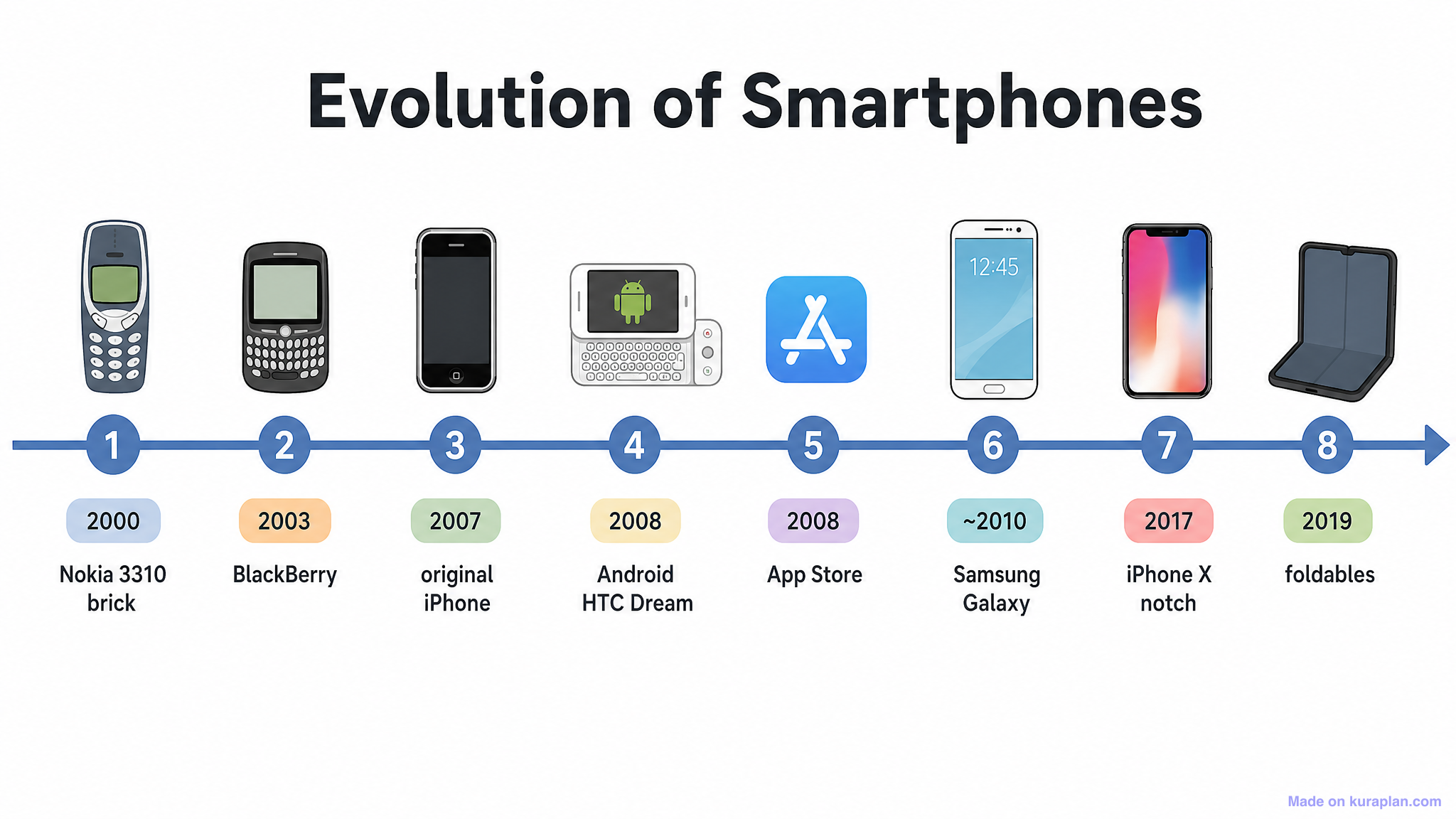
At first, portable phones were only usefull for calling, or sending SMS messages. For this reason, they first began very small, so that they could fit inside any pocket. The commands were simple, as there wasn’t a lot of options of things to do apart from the primary usage of the phone. The size began to grow bigger as more functionality were added. The true revolution began with the first iPhone, that remove the traditional button and replaced it with a touch-screen. With this new technology, they also added many functionalities, such as browsing Internet or downloading apps through the App Store. Using a touch screen quickly became the norm, and smartphones tried to ride the wave by creating phones with bigger and bigger screens, until no button was left on the front panel (like the iPhone X for example). Now that smartphones have grown big, new technologies are being created to make them contact again, introducing foldable phones.
In the future, this new trend is likely to continue, with the arrival of rollable phones or phones that have screens that can extend. With this new innovations, phone size could eventually come back to a more compact, pocket-sized format, while still being able to be confortable for any kind of usage.
“The Computer for the 21st Century”, by Mark Weiser#
In his landmark 1991 Scientific American paper, “The Computer for the 21st Century,” Mark Weiser introduced the concept of ubiquitous computing (or “embodied virtuality”).
“The most profound technologies are those that disappear. They weave themselves into the fabric of everyday life until they are indistinguishable from it.”
In this paper, Weiser talks about the “Hardware Trinity” of Tabs, Pads and Boards, which are already present nowadays in the form of smartwatches, tablets and smart TVs. He also mentions ubiquitous radio networks : with WiFi 6/7, Bluetooth and 4G, 5G or even 6G that should appear in the future, all our devices are interconnected without the need of cables.
But Weiser’s vision is still not complete. He wrote : “Pads are intended to be ‘scrap computers’ that can be grabbed and used anywhere; they have no individualized identity or importance”. Phones and tablets are still too expensive to produce and purchase to be considered “scrap”, as anybody wouldn’t want to break their precious phone. As a phone holds a lot a data that the user cares for and uses, the way it stored would need to be entirely remote, so that the device itself doesn’t hold that much importance. Then, any device would need to be able to adapt to any user and allow them to access their data, while also following the user’s natural way of interacting with the device to remain seemless. This create a concern for privacy as it would need the data to be perfectly secured.
The future MR App Store#
As mixed reality headsets will eventually replace smartphones, the traditional apps we know will become obsolete. Instead of opening isolated programs, users will toggle persistent, context-aware layers that augment work, navigation, and human memory in real time. Let’s get over some ideas for the most used MR apps of the future.
First, it is fair to expect most common applications to have a port in the MR environment. Messagerie apps will allow the user to consult new messages in the corner of their field of view. Music apps will have their icon integrated as well so the user can change their playlist with the flick of a finger. Navigation apps will be very useful, guiding the users in real time, with easy to understand visual clues.
Some new innovations will also eventually arise. For example, there could be some sort of visual research tool, where the user would point something of manipulate a virtual frame to select a part of the field of view to make a research about it on the internet. Like a Google Image search, but mixed with the real world in real-time. Something similar to this could even extend with a tool to find objects. For example, if the user is looking for a specific object but cannot find it, an MR app could help him detect it as soon as the object enters the field of view of the user, and/or indicate its location clearly.
In the end, the killer app of mixed reality won’t be something you look at, but the lens through which you experience everything else.